
How to Read a Nutrition Label on Kids Snacks (And Why Most Parents Are Getting Burned)
Wild Child Outfitters
Oct 03 2026
How to Read a Nutrition Label on Kids Snacks (And Why Most Parents Are Getting Burned)
The brands you trust most are counting on you not to flip the bag over.
If you have ever stood in the snack aisle, picked up something that looked perfect on the front, flipped it over, and quietly put it back on the shelf, you are not alone.
This happens to parents every single day. The front of the package says organic. The ingredient list says organic cane sugar in third place. The front says no artificial colors. The back has 'natural flavors' listed with no explanation of what that actually means. The front says made with real fruit. The back shows fruit juice concentrate after three other forms of sugar.
You did everything right. You read the label. The label just was not being straight with you.
This post is about changing that. Not with a complicated nutrition degree or a long list of ingredients to memorize. With a simple framework, a free app that does most of the work for you, and one real product as the case study so you can see exactly what passing every test actually looks like.
Why Front-of-Package Claims Are Designed to Stop You From Reading Further
The FDA regulates what food companies can and cannot say on the front of a package, but the rules leave significant room for claims that create a healthy impression without requiring the product to actually be healthy.
A product can be labeled:
- "Natural" with no legal definition attached to that word
- "Made with organic ingredients" while containing as little as 70% organic content and still using conventional pesticide-treated ingredients for the rest
- "No high fructose corn syrup" while containing multiple other forms of added sugar
- "A good source of fiber" while also containing more added sugar per serving than a small cookie
These are not accidents. Front-of-package claims exist to stop your eyes at the front of the bag. The back of the bag is where the real information lives. The front is marketing.
Research has documented this gap. A study published in the journal Nutrients found that front-of-package nutritional labeling systems varied widely in their ability to help consumers correctly identify healthier products, with many systems failing to flag products with high added sugar content. Parents who relied on front-of-package signals alone made systematically worse choices than those who checked the full nutrition facts panel and ingredient list.
The fix is simple. Always flip the bag.
Meet YUKA: The Free App That Flips the Bag for You
YUKA is a free app available on iOS and Android. You open it, point your phone camera at a product barcode, and it tells you exactly what is in the product and how those ingredients score against health and safety databases.
It pulls from the Open Food Facts database and cross-references ingredients against research on food additives, pesticide residues, nutritional quality, and processing levels. It gives each product a score out of 100 and a color-coded rating: excellent, good, mediocre, or poor.
Here is what the interface looks like in practice.

This is a standard YUKA scan result. You can see the overall score, the color-coded rating, the breakdown of what is contributing positively and negatively to the score, and specific flags for ingredients that carry documented concerns.
YUKA does not replace reading the label yourself. But it gives parents a fast, research-backed second opinion at the moment of decision, standing in the aisle with a toddler in the cart and thirty seconds to make a call.
You can download YUKA here: https://yuka.io/en/
We will be submitting Adventure Fuel to YUKA when it launches. We want you to scan it. We are not nervous about what it will find.
The Five-Part Label Reading Framework
Whether you use YUKA or not, here is the framework that should govern every snack you buy for your kids. It takes about 45 seconds once you know what to look for.
1. Find Added Sugar and Find It Fast
Flip to the nutrition facts panel first. Look for the line that says Added Sugars. This is a separate line from Total Sugars, which includes naturally occurring sugars from fruit and dairy.
The American Heart Association recommends that children ages 2 to 18 consume no more than 25 grams of added sugar per day, and children under 2 should have none at all.
A single serving of many kids snacks marketed as healthy contains 8 to 12 grams of added sugar. That is nearly half a child's daily limit in one small bag before lunch.
What to look for on the ingredient list alongside the nutrition panel: added sugar hides under dozens of names. Cane sugar, brown rice syrup, honey, agave nectar, fruit juice concentrate, dextrose, maltose, and evaporated cane juice are all added sugar. If any of these appear in the first three ingredients, the snack is built around sugar regardless of what the front of the bag claims.
What Adventure Fuel will sow on the panel: 0.4 grams of added sugar per serving.
Here is where that comes from and why we are telling you directly.
Sourcing fully unsweetened organic banana chips at our current production volume turned out to be one of the hardest ingredient problems we ran into. The options that existed at our order size either were not organic, had added sugar higher than we were willing to accept, or both. We landed on the best available option at this scale: organic banana chips with a very small amount of added sugar that puts the total per serving at 0.4 grams.
We are putting 0.4 grams on the label. Not rounding down. Not hiding it under a different name. Not burying it in fine print.
Technically we could claim 'Zero Added Sugar' like all the other brands. But this brand was built to be better - and there is nothing better than real transparency.
As Wild Child Outfitters grows and our order volume opens up better sourcing options, we intend to move to fully unsweetened organic banana chips and bring that number to zero. That is the goal. We are not there yet, and we are not going to pretend otherwise.
To put 0.4 grams in context: the average kids snack marketed as healthy contains 8 to 12 grams of added sugar per serving. Adventure Fuel contains 0.4 grams from one ingredient, disclosed directly, with a public commitment to eliminate it as sourcing allows.
That is what honest labeling looks like from a brand that actually wants you to flip the bag over.
2. Check Where Protein and Fiber Show Up
Protein and fiber are the two nutrients most consistently linked to satiety in children, the feeling of actually being full rather than just having eaten something.
A randomized crossover study published in the American Journal of Clinical Nutrition found that meals built around plant protein and fiber from legumes produced significantly greater fullness, lower hunger, and approximately 12 to 13 percent lower energy intake at the following meal compared to meals built around other protein sources. For a snack designed to keep active kids fueled through a hike, a park afternoon, or a long drive, those two numbers matter more than almost anything else on the label.
What to look for: protein of at least 3 to 4 grams per serving and fiber of at least 2 to 3 grams per serving in a snack intended to bridge the gap between meals.
What to watch out for: snacks that show 1 gram of protein and 0 grams of fiber are delivering quick calories with no staying power. Your kid will be hungry again in 20 minutes. What Are the Healthiest Snacks for Kids on the Go?
Adventure Fuel: Roasted chickpeas and pumpkin seeds form the protein and fiber foundation of the mix. Both ingredients are doing structural nutritional work, not just filling space in the bag.
3. Look at the Fat Source, Not Just the Fat Amount
Total fat on a nutrition label tells you very little by itself. The type of fat and where it comes from tells you everything.
Healthy fats from whole food sources like nuts, seeds, and coconut support energy, nutrient absorption, and brain development in growing kids. These are the fats you want to see.
Refined oils like sunflower oil, soybean oil, palm oil, and generic vegetable oil are a different story. They appear in nearly every processed snack food and are often the first or second ingredient after the base ingredient. They are cheap, shelf-stable, and nutritionally unremarkable.
What to look for on the ingredient list: nuts, seeds, nut butters, avocado, or coconut listed as the fat source.
What to avoid: products where the first fat-containing ingredient is a refined oil. This is especially common in crackers, puffs, and baked snacks that appear healthy on the front of the package.
Adventure Fuel: Macadamia nuts, pistachios, pumpkin seeds, and toasted coconut are the fat sources. Every gram of fat in the bag comes from a recognizable whole food.
4. Count the Ingredients and Recognize Them All
This is the simplest test and often the most revealing.
Pick up the bag. Flip it over. Read the ingredient list out loud, or at least in your head. If you hit an ingredient you cannot identify, cannot pronounce, or would not find in your own kitchen, that ingredient is worth questioning.
This does not mean every unfamiliar ingredient is dangerous. It means the product has moved further from whole food and closer to engineered food, and that shift usually means more processing, more additives, and less nutritional integrity.
A short, recognizable ingredient list is one of the most reliable signals of a genuinely clean product. Not because shorter is always better, but because brands using real ingredients do not need a long list of additives to make the product taste acceptable.
The FDA requires that ingredients be listed in descending order by weight. The first ingredient is what the product is mostly made of. If the first ingredient is a refined grain, a sugar, or an oil, that is the foundation of the product regardless of what the front of the bag says.
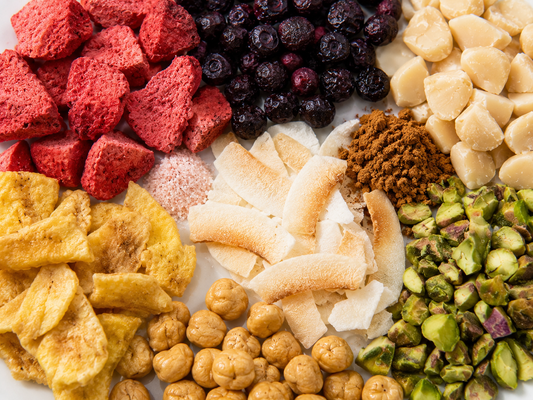
Adventure Fuel: Roasted chickpeas, pumpkin seeds, plantain chips, freeze-dried strawberries, freeze-dried blueberries, macadamia nuts, pistachios, toasted unsweetened coconut, cinnamon, salt. Every ingredient is something you would recognize at a grocery store. None of them require an explanation.
5. Understand What Organic Actually Means on the Label
Organic certification is one of the more misunderstood claims in the snack aisle. Not because parents are uninformed, but because the labeling system has multiple tiers that look similar from a distance and are not.
Here is what the different organic label claims actually mean under USDA rules:
- "100% Organic" means every ingredient is certified organic
- "Organic" means at least 95 percent of ingredients are certified organic
- "Made with Organic Ingredients" means at least 70 percent of ingredients are certified organic. The remaining 30 percent can be conventionally grown.
- No organic claim on the front with individual organic ingredients listed in the ingredient list means less than 70 percent of ingredients are certified organic
Research has documented meaningful differences in pesticide residue levels between conventionally grown and organically grown produce, particularly for crops that appear on the Environmental Working Group's annual Dirty Dozen list. For children, who consume more food relative to their body weight than adults and whose developing systems are more sensitive to pesticide exposure, this distinction carries real weight. [Cross-link to Post 9: Are Organic Snacks Actually Better for Kids]
What to look for: the USDA Organic seal on the packaging, which confirms third-party certification rather than a self-applied marketing claim.
Adventure Fuel: Certified organic. Not "made with organic ingredients." Not organic-ish. The USDA seal is on the bag because the standard was met, not because it made good copy.
What a Label That Passes Every Test Actually Looks Like
Here is the Adventure Fuel ingredient list in full:
Roasted chickpeas, pumpkin seeds, plantain chips, freeze-dried strawberries, freeze-dried blueberries, macadamia nuts, pistachios, toasted unsweetened coconut, cinnamon, salt.
Run it through the framework:
- Added sugar: 0.4g per serving - we are working towards the No Added Sugar claim.
- Protein and fiber: Present in meaningful amounts from chickpeas and pumpkin seeds
- Fat source: Whole food fats from macadamia nuts, pistachios, pumpkin seeds, and coconut
- Ingredient list: Ten ingredients, every one recognizable
- Organic certification: USDA certified
This is what a label that has nothing to hide looks like. No added sugar disguised under a different name. No refined oils buried in the middle of the list. No natural flavors doing work that real ingredients should be doing.
When Adventure Fuel launches, scan it on YUKA. We will be right there with you waiting to see the score.
The 45-Second Label Check, In Order
Next time you are standing in the snack aisle with a product in your hand, run this in order:
- Added sugars line on the nutrition panel. Zero or close to it is the target.
- Protein and fiber. At least 3 grams of each for a snack intended to satisfy.
- First fat-containing ingredient. Whole food or refined oil?
- Ingredient list length and recognition. Can you say them all out loud?
- Organic claim. USDA seal or marketing language?
Forty-five seconds. That is all it takes to know whether the product matches what the front of the bag promised.
Or open YUKA and point it at the barcode. Either works.
References
- Front-of-Package Nutritional Labeling and Consumer Choice — Nutrients. Review of research on how front-of-package labeling systems affect consumer purchasing decisions and their accuracy in identifying healthier products.
- Meals based on vegetable protein sources are more satiating than meals based on animal protein sources — American Journal of Clinical Nutrition. https://ajcn.nutrition.org/article/S0002-9165(23)23828-9/fulltext
- FDA Food Labeling Guide: Ingredient Lists — U.S. Food and Drug Administration. https://www.fda.gov/food/food-labeling-nutrition/ingredients-declared-food-label
- USDA Organic Labeling Standards — U.S. Department of Agriculture. https://www.ams.usda.gov/grades-standards/organic-labeling-standards
- Added Sugars on the Nutrition Facts Label — FDA. https://www.fda.gov/food/new-nutrition-facts-label/added-sugars-new-nutrition-facts-label
- American Heart Association: Added Sugars and Children. https://www.heart.org/en/healthy-living/healthy-eating/eat-smart/sugar/added-sugars
- EWG Dirty Dozen 2024. https://www.ewg.org/foodnews/dirty-dozen.php
- YUKA App. https://yuka.io/en/
Related articles
What Are the Healthiest Snacks for Kids on the Go? A Real-Food Guide for Parents
Sep 19 2026
Post by
Wild Child Outfitters

What Is in Adventure Fuel Trail Mix? Every Ingredient Explained (With Research)
Sep 14 2026
Post by
Wild Child Outfitters